19
Sessions before exhaustion
Weekly psychology can consume the entire $5,000 envelope before mid-year.
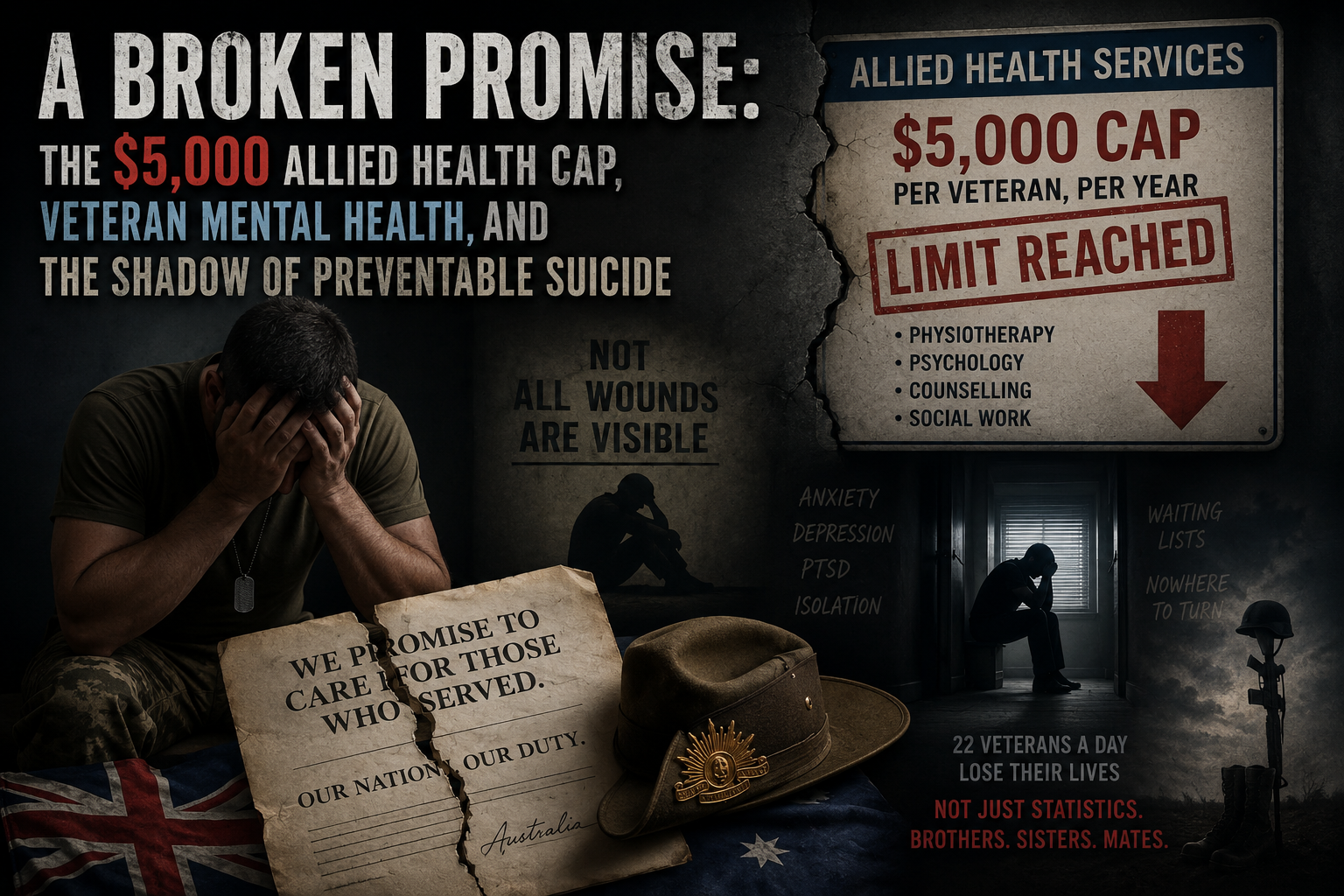
The $5,000 Allied Health Cap, Veteran Mental Health, and the Shadow of Preventable Suicide.
This independent white paper examines why applying the proposed DVA allied health cap to psychological and mental health treatment is clinically unsafe, ethically indefensible, and inconsistent with the duty of care owed to Australian veterans.
“My heartfelt fear is that this $5,000 cap will one day be remembered not for the money it saved, but for the veterans it failed. We absolutely know that psychological treatment saves lives. We also know that barriers to treatment place vulnerable people at even greater risk. There can be little doubt that some veterans’ lives shall be lost, and families destroyed forever, because the support they depended upon became harder to access. That death will leave a question that should never have needed to be asked: How, after everything that was learned through the Royal Commission into Defence and Veteran Suicide, did we allow such an unconscionable policy to ever see the light of day?”
The proposed limit is not a psychology cap. It is a single annual pool across allied health services, including physiotherapy, psychology, occupational therapy, podiatry, exercise physiology and dietetics/nutrition.
That means a veteran managing both physical injuries and psychological trauma could exhaust the cap within weeks or early months, leaving mental health treatment dependent on an override process rather than clinical need.
The white paper's worked examples show how quickly this happens when physical rehabilitation and weekly psychology draw from the same capped envelope.
A veteran with PTSD and chronic lower back injury receiving fortnightly physiotherapy and weekly psychology can exhaust the cap around August. In that scenario, active PTSD treatment is interrupted after only four psychology sessions.
At a post-cap rate of approximately $260 per psychology session, a veteran attending weekly treatment can exhaust the proposed annual cap in fewer than 20 sessions — before evidence-based PTSD treatment is complete.
Weekly psychology can consume the entire $5,000 envelope before mid-year.
Many veterans with PTSD and complex trauma require sustained treatment across the year.
Psychology, physiotherapy, OT, podiatry and exercise physiology compete within the same cap.
The Royal Commission into Defence and Veteran Suicide concluded in 2023 after years of testimony, evidence, and national grief. Its recommendations were explicit and unambiguous. The $5,000 cap contradicts four of them directly — while the Budget papers selectively cite only the recommendation that supports the fee increase.
The Government cannot simultaneously claim to be implementing the Royal Commission's recommendations and introduce a financial cap that structurally limits access to psychological treatment. The Budget papers cite Recommendation 71 — the fee increase — while the cap materially undermines Recommendations 31, 33, 35, and 66. That selective citation requires direct parliamentary and public scrutiny.
The Commonwealth must strengthen accountability mechanisms for DVA's management of veteran mental health cases, with particular attention to continuity of care.
DVA must ensure veterans are not required to repeat or interrupt evidence-based psychological treatment due to administrative or financial barriers.
DVA must improve its responsiveness to veterans with complex needs, including those requiring long-term psychological support beyond standard referral cycles.
The Commonwealth must treat suicide prevention as a whole-of-system responsibility and remove structural barriers to veteran access to mental health services.
The Royal Commission was convened because veterans were dying. Its recommendations were the nation's formal commitment that the system would change. The $5,000 cap is not an implementation of those recommendations. It is a reversal of them. Every parliamentarian who votes to proceed without exempting psychological services from the cap is voting against the Royal Commission's explicit findings on veteran suicide prevention.
The Government presented the fee increase and the $5,000 cap as complementary benefits for veterans. The arithmetic tells a different story. Paying more per session while holding the annual envelope constant produces one mathematically certain outcome: fewer sessions funded per year.
The Government is paying psychologists 58% more per session and funding 37% fewer sessions per year. The net beneficiary of this arithmetic is the Commonwealth's fiscal position — projected savings of $748 million over three years. The net loser is the veteran in active treatment whose sessions run out before evidence-based therapy is complete.
For the override mechanism to function, DVA must assess whether ongoing treatment is clinically necessary. That assessment requires clinical information — session content, risk assessments, diagnostic formulations, trauma disclosures. This is among the most sensitive material a veteran has ever shared with anyone.
Effective psychological treatment for PTSD and complex trauma depends on an unconditionally confidential therapeutic space. Veterans disclose operational trauma, moral injury, and experiences they have shared with no other person — because the law and professional ethics guarantee that disclosure stays within the treating relationship. That guarantee is the precondition for treatment to work.
To approve continued treatment above the cap, DVA must receive clinical information — the nature of treatment, the veteran's risk profile, the psychologist's clinical assessment. That information then enters a government bureaucracy with data-sharing arrangements across the ADF, the Australian Federal Police, and the Department of Home Affairs. The veteran loses control of it permanently.
When the $5,000 cap is exhausted, the Government's implicit answer is Open Arms — Veterans and Families Counselling. It is DVA-funded, DVA-administered, and free to access. It is also the service that a significant and clinically well-documented proportion of the highest-risk veterans will categorically refuse to use — not because of any deficiency in clinical staff, but because of its structural relationship with DVA.
Veterans in the middle of compensation disputes fear that psychological disclosures to a DVA-funded service could be seen, used, or shared in ways that damage their claim. That fear is not irrational. It is historically grounded in the adversarial nature of the DVA claims process.
Personnel from sensitive roles carry the perception — often well-founded — that psychological disclosure to any government-proximate service carries career, clearance, or security implications. For this cohort, Open Arms is structurally unacceptable regardless of its clinical quality.
Veterans who have experienced prolonged claim delays, disputed liability decisions, or inadequate compensation outcomes do not regard DVA as a source of support. For them, Open Arms sits within the same institutional structure that has already failed them.
The cohorts most likely to refuse Open Arms engagement are, without exception, among the highest-risk and highest-need veterans in the DVA caseload. For them, the policy produces not a safety net but a three-way trap: private psychology capped and inaccessible, Open Arms structurally unacceptable, and the override process requiring disclosure to the very organisation whose trustworthiness is in question. When all three pathways are blocked, veterans do not find a fourth option. They disengage from treatment entirely.
The cap is scheduled to commence on 1 July 2027. Every signature increases the pressure for change before that date arrives.
Australians raise their voice and share the evidence.
Community support builds pressure for change.
Representatives are asked to scrutinise the policy before commencement.
The cap commences unless the policy is changed.
Veterans facing the proposed $5,000 Allied Health Cap are not presented with a genuine choice. Instead, many will find themselves trapped between three unacceptable pathways.
1. Exhaust the Cap
The shared allied health budget may be consumed by physiotherapy, occupational therapy, exercise physiology, dietetics and psychological treatment long before the financial year ends.
2. Enter the Override Process
To continue treatment, veterans may be required to justify their need through an administrative process that transfers decision-making away from their treating clinicians.
3. Disengage from Treatment
For some veterans, concerns about confidentiality, trust, administrative burden, or simple exhaustion with the system may result in treatment ending altogether.
The consequence is not theoretical. It is the real-world risk that veterans who are already vulnerable may lose access to the care that keeps them safe, stable and connected.

Independent voices. Shared concerns. One objective. This white paper and Rebecca Lorraine's Change.org petition are separate initiatives, but they support the same outcome: stopping a policy that risks interrupting care for veterans who need it.
Provides the evidence, clinical analysis and policy arguments needed to understand the likely consequences of the proposed $5,000 Allied Health Cap.
Provides a public mechanism for Australians to demonstrate concern, build visible community pressure, and call on the Government to honour its commitment to veterans.
A central theme of Rebecca Lorraine's petition is the Australian Veterans' Covenant: the national promise that those who served will be recognised, respected and supported.
The petition asks a simple but powerful question that deserves serious consideration before this measure proceeds:
Is a policy that limits access to treatment for service-related physical and psychological injuries consistent with the promise Australia has made to its veterans?
This is not a competition between campaigns. The white paper provides the evidence. Rebecca Lorraine's petition provides the public voice. Together, they help ensure that the concerns of veterans, families and clinicians cannot be ignored.
Support Rebecca Lorraine's PetitionOne petition builds public pressure. The other creates a formal parliamentary record. Together, they help show that veteran mental health care should be determined by clinical need, not an arbitrary financial ceiling.
Build public awareness and demonstrate broad community concern through Rebecca Lorraine's national petition.
Direct the issue into the formal parliamentary process.
"This is not about politics. It is about whether Australia honours the promise it made to those who served."David G. Broadbent
When all three pathways are blocked — financially, structurally, or by confidentiality risk — veterans may disengage from treatment. The consequence is not administrative. It is human.

For some veterans, disengagement means untreated PTSD, untreated depression, untreated anxiety, and the loss of the therapeutic relationship that may have been keeping them stable.
When the cap is exhausted, the veteran is left with three unacceptable choices: stop treatment, enter an uncertain administrative override process, or move to a service they may not trust.
The policy debate is ultimately about people, not budgets. A veteran who withdraws from care because the system has become too difficult, too intrusive, or too uncertain has not ceased to need help. They have simply become harder to see.
The white paper calls for action before the cap takes effect.
Psychology and mental health-related services should sit outside the allied health cap.
Any override pathway must have clinical criteria, rapid timeframes, and qualified decision-makers.
Clinical impact and suicide risk assessments should be completed before implementation.
Existing therapeutic relationships must not be disrupted by the introduction of the cap.
The competitive neutrality question should be independently examined.
Find your Federal MP and open a pre-written email asking them to protect veteran mental health care.
This first version uses a small local suburb/postcode map. If your location is not mapped yet, use the AEC lookup button, then enter your electorate name in the search box.
Postcodes can cross electorate boundaries. For certainty, confirm your electorate with the AEC if unsure.
If you already know your Federal electorate, start typing it below.
This text is inserted when you click the email button.
Select your State or Territory to display your Federal Senators and open pre-written emails asking them to oppose the cap.
Senators represent whole States or Territories. Choose the place where you live.
This displays Federal Senators only. It does not include State Parliament representatives.
After selecting your State or Territory, use the email buttons below. Each button opens a separate email so your message can be sent personally.
This text is inserted when you click each Senator email button.

Registered Psychologist
Safety Psychologist
D.G. Broadbent & Associates
Transformational Safety®
Maitland NSW
David G. Broadbent is a registered psychologist and Safety Psychologist with clinical experience in military and veteran populations.
This white paper represents his professional and clinical opinion on the risks created by applying the proposed DVA allied health cap to psychological and mental health treatment.
Sign the petitions, share the white paper, and help ensure this policy is changed before 1 July 2027.